Market Scenario
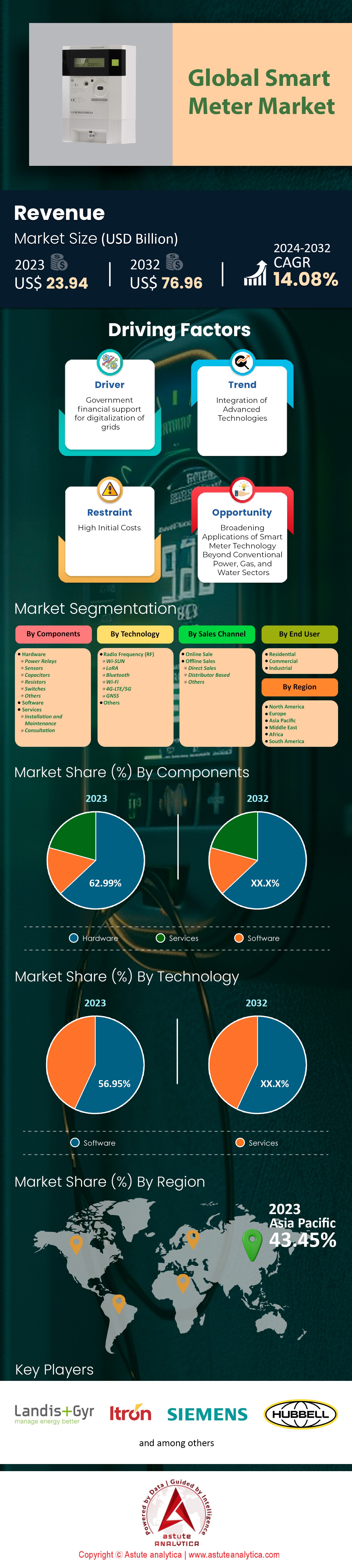
Smart meter market size was valued at USD 30.19 billion in 2025 and is projected to hit the market valuation of USD 112.71 billion by 2035 at a CAGR of 14.08% during the forecast period 2026–2035.
Smart Meter Market Overview: Valuation & Trajectory
- Current Valuation: USD 31.16 Billion (2025)
- Future Projection: USD 116.32 Billion (2035)
- CAGR: ~14.08%
- Largest Region: Asia Pacific
- Largest Component: Hardware (62.99%)
- Major Technology: Radio Frequency (RF) technology (56.95%)
- Key Sales Channel: Offline Distributors (76.78%)
The global smart meter market has moved past simple automated reading. It is now an edge-computing arms race characterized by a fundamental business model shift. With a $31.16 billion valuation in 2025, the market is pivoting from CAPEX-heavy hardware rollouts to TOTEX (Total Expenditure) service models.
The "so what?" for investors and utility stakeholders is clear: hardware commoditization is real, and the value has shifted to the "Grid Edge" and "Data-as-a-Service." In high-growth markets like India, utilities are no longer buying meters; they are buying 10 years of guaranteed data uptime from Advanced Metering Infrastructure Service Providers (AMISPs).
While India executes the world's largest greenfield rollout (targeting 250 million units under RDSS), North America and China are entering a massive "replacement cycle" (2025–2027). The winners in this phase are not just box-shifters, but players like Itron and Landis+Gyr integrates AI and advanced edge computing into smart meters via its Revelo® platform, leveraging high-resolution waveform sensing (1MHz sampling) and onboard ML for real-time grid analytics. Revelo features proprietary sensing chips for anomaly detection, arc faults, and DER integration, paired with partners like Sense for 1MHz processing and Utilidata/Grid4C for AI-driven voltage optimization.
The smart meter market is bifurcated. In emerging economies, growth is volume-driven by government mandates. In mature markets (US, UK, Nordics), growth is value-driven by the replacement of 10-15-year-old "dumb" smart meters with "AMI 2.0" devices capable of high-resolution waveform capture.
To Get more Insights, Request A Free Sample
Which Government Mandates & Regulatory Policies Driving the Numbers?
- India (RDSS): The Revamped Distribution Sector Scheme has sanctioned over 222 million smart meters, with a total outlay of roughly ₹3 lakh crore ($36B). This is the single largest volume driver globally.
The mandate ties central government funding for Discoms (distribution companies) to the successful deployment of smart metering, creating financial coercion that ensures project completion unlike previous failed schemes (e.g., UDAY).
- China (State Grid):A new bidding cycle (2025–2027) targets the replacement of first-gen meters installed between 2010–2015. 2025 tenders alone cover ~66 million units.
China smart meter market is moving toward IR46 standards, which mandates a "dual-core" design: one core for legal metrology (unalterable) and one core for extensible applications (software upgrades), allowing meters to evolve like smartphones.
- EU Directives: The push continues for 80% coverage by 2030, with Germany finally accelerating its rollout for consumers over 6,000 kWh/year starting in 2025.
- USA (IIJA Funding): The Infrastructure Investment and Jobs Act allocates $3 billion specifically for Smart Grid Investment Grants (SGIG), incentivizing utilities to upgrade to AMI 2.0 for EV load management.
RF Mesh vs. Cellular vs. PLC: Who is Winning the Battle for Connectivity in Smart Meter Market?
- RF Mesh (Radio Frequency):
Dominant region for deplyment: North America, Japan, & Australia.
Why: High reliability (99.9% SLA) and low latency. It forms a self-healing network independent of public telecom carriers.
Key Players: Itron (OpenWay Riva), Landis+Gyr (Gridstream).
The adoption of the Wi-SUN field area network standard is critical here, preventing vendor lock-in by allowing different brands of meters to talk on the same mesh network.
- Cellular (NB-IoT / 4G):
This technology is mainly dominant in India smart meter market, parts of Eastern Europe, and China. These meters lower CAPEX (no need to build towers/gateways). As a result, utilities piggyback on existing telecom infrastructure (Jio/Airtel in India). However, OpEx exposure to telecom data tariff hikes and "sunset" risks (e.g., when 2G/3G networks were shut down, legacy meters went dark).
- PLC (Power Line Communication):
PLC based smart meters are heavily deployed across France (Linky project), Spain, and Italy. This technology uses existing power lines for data. Cost-effective for dense urban clusters but struggles with noise/interference in regions with poor grid power quality (like India or Latin America).
Which Proprietary Technologies Define the Smart Meter MarketLeaders?
- Landis+Gyr: Linked to Revelo. This is their flagship grid-sensing meter that streams high-resolution waveform data (processing 15 kHz) to detect faults before they happen.
- Itron: Linked to Distributed Intelligence (DI) and OpenWay Riva. Recent partnership with NVIDIA (March 2025) brings AI computing directly to the meter edge.
- Schneider Electric: Linked to EcoStruxure ADMS. They don't just measure; they integrate meter data into the wider Advanced Distribution Management System to balance renewable loads.
- Honeywell (Elster): Linked to Connexo, a unified utility intelligence platform. Strong foothold in gas and water metering integration.
- IntelliSmart (India): A joint venture (EESL + NIIF) acting as a super-aggregator, managing a portfolio of ₹20,000 crore in projects. They pioneered the "totex" model where they finance the meter and lease it to the utility.
How Are M&A and Consolidation Reshaping the Competitive Landscape?
The smart meter market is consolidating into two camps: High-Tech Integrators (Western players focusing on AI/Software) and High-Volume Manufacturers (Asian players focusing on scale).
Current Market Leaders: Landis+Gyr, Itron, and China's Wasion Group hold the top tier.
Challengers: Genus Power (India) is rapidly climbing global rankings by sheer volume of RDSS orders. Polycab and Adani Energy Solutions are new, aggressive entrants in the Indian turnkey space.
Strategic M&A Compelling Consolidation in Smart Meter Market
Landis+Gyr sells EMEA Business (2025): A massive move exiting the hardware-heavy European market to double down on US/APAC software.
Ancala acquires Solandeo (Germany): Infrastructure funds are buying into metering service providers (MSPs) to capture long-term recurring revenue.
Hubbell acquires Systems Control: Strengthening the substation and grid automation portfolio to complement metering.
Why is "Grid Edge AI" the Single Most Critical Trend Shaping the Future of Smart Meter Market?
The single most important trend is the shift from Meter-to-Cash (billing) to Meter-to-Grid (operational control). Here, old meters sent one reading every 15 minutes to the cloud for processing. However, New "AMI 2.0" meters process data inside the meter using on-board AI chips.
Use Case: An Itron meter with NVIDIA chips can detect a "high impedance" fault (like a downed line that hasn't sparked yet) and cut power in seconds, preventing wildfires—a massive selling point in California and Australia.
Consumer Insight (Load Disaggregation): New meters can identify specific appliances. They know the difference between an EV charging and an AC unit running based on the "harmonic signature" of the power draw. This allows utilities to offer "EV-only" tariffs without needing a second meter.
Segmental Analysis
By Technology, RF Mesh Networks Secure Critical Grid Autonomy and Capture Over 56.95% Market Share
Utilities across the global smart meter market prefer Radio Frequency (RF) Mesh over Cellular (NB-IoT) because it offers Private Network Ownership. By deploying RF Mesh, utilities own the infrastructure, eliminating the risk of paying recurring data fees to telcos (OPEX) and avoiding coverage blackspots in rural or basement locations. For instance, Itron’s OpenWay Riva and Landis+Gyr’s Gridstream Connect rely heavily on this topology, utilizing Wi-SUN standards to create self-healing networks that reroute data during storms—critical for grid resilience. Recent data confirms RF Mesh holds ~55.9% of the communication market, as North American and Japanese utilities (e.g., TEPCO) refuse to cede control of their critical infrastructure to third-party cellular carriers.
- Key Indicators: Dominance in North American & Japanese tenders; Wi-SUN Alliance certified ecosystem.
- Leading Entities: Itron (OpenWay Riva), Silicon Labs (Wi-SUN Chips), Silver Spring (Legacy Mesh).
By Component, Physical Infrastructure Dominates Capital Expenditure
Despite the "SaaS" hype, the smart meter market’s revenue reality remains brutally hardware-centric. You cannot monetize grid-edge intelligence without first deploying the physical sensor. This 62.99% market share held by hardware component is fueled by massive government‑mandated rollouts, specifically India’s RDSS (Revamped Distribution Sector Scheme) and Europe's second‑generation upgrades.
For instance, Landis+Gyr’s FY2023 financials reveal that Device Solutions still account for the lion’s share of its USD 1.96 billion revenue, driven by shipping 20 million devices globally. Similarly, India’s Genus Power boasts an order book exceeding ₹31,000 Crore (USD 3.7 billion), almost entirely composed of hardware‑heavy AMISP contracts. Utilities are capitalizing these assets upfront to meet regulatory deadlines, ensuring that hardware remains the primary revenue engine.
- Key Indicators: High CAPEX cycles in India (RDSS) and Eastern Europe.
- Leading Entities: Landis+Gyr (Revelo Meters), Itron (Centron), Genus Power (Smart Pre-paid Meters).
Customize This Report + Validate with an Expert
Access only the sections you need—region-specific, company-level, or by use-case.
Includes a free consultation with a domain expert to help guide your decision.
By Sales Channel, Complex Procurement Demands Strengthen the Dominance Offline Distributors, which Capture Over 76.78% Market Share
Smart meters are highly regulated critical infrastructure, not commodities, they are not purchased via e-commerce carts. The 76.78% market share of Offline Distributors in the smart meter market reflects the necessity of negotiated procurement involving complex Requests for Proposals (RFPs) and long-term supply agreements. Major industrial distributors like WESCO and Rexel are essential for bridging the gap between manufacturers and the thousands of fragmented municipal utilities and rural co-ops that lack the buying power of a National Grid. These intermediaries provide essential logistics, "kitting" (bundling meters with connectors/boxes), and credit facilities that digital channels cannot match. Contrary to the digital trend, the "Offline" channel is growing as supply chain volatility forces utilities to rely on partners with deep physical stock rather than just-in-time direct shipments.
- Key Indicators: High reliance on RFPs (Requests for Proposals) and "Approved Vendor Lists."
- Leading Entities: WESCO International, Rexel, Anixter (Supply Chain Solutions).
To Understand More About this Research: Request A Free Sample
Regional Analysis: Where Are the Global Hotspots, and Who Holds the Largest Order Books in Smart Meter Market?
Asia-Pacific: The Global Engine
Verdict: Dominates with 36–45% market share.
India's Order Book Explosion (2024-25):
- Genus Power Infrastructures: Reports a staggering order book of >₹31,300 Crore (~$3.7B) as of Dec 2024. Their partnership with GIC (Singapore Sovereign Wealth Fund) provides the capital to execute these massive service contracts.
- HPL Electric & Power: Order book stands at >₹3,400 Crore, with 99% of orders being smart meters.
- IntelliSmart: Has secured "TOTEX" projects for 6.7 million meters in UP and 5.1 million in Gujarat.
However, the Indian smart meter market faces a bottleneck in chip supply. Wherein, local content requirements necessitate domestic manufacturing, but the microcontrollers are still largely imported.
China: Shipment volumes remain massive (~128 million units/year), but the market is closed to non-domestic players. The focus here is strictly on the State Grid Corporation of China (SGCC) replacement cycle.
Japan: TEPCO (Tokyo Electric Power) is initiating its second-generation rollout. Unlike the first wave (focused on billing), this wave focuses on disaster resilience and integrating distributed energy resources (DERs).
North America: The "Second Wave"
- Verdict: High value, lower volume.
Utilities across the global smart meter market are swapping early 2010s meters for distributed intelligence. This is mainly because, the US smart meter penetration is already >79%. The growth is in software and analytics services, not just hardware boxes. In addition to this, The "Opt-out" movement (health concerns regarding RF radiation) has largely subsided, allowing utilities to push for 100% coverage to support Time-of-Use (TOU) pricing models.
Europe: The Laggard Catching Up in Smart Meter Market
Verdict: Fragmented and Complex.
- Landis+Gyr Divestment: In a strategic pivot, Landis+Gyr is selling its EMEA metering business to Aurelius (Equity Firm) for $215M to focus on the higher-margin Americas market. This signals the difficulty of the fragmented European regulatory landscape.
- UK Challenges: The transition from SMETS1 to SMETS2 (Smart Metering Equipment Technical Specifications) has been plagued by connectivity issues, as early meters went "dumb" when consumers switched energy suppliers. The DCC (Data Communications Company) network is now stabilizing this.
Analyst View: Where Should Investors Place Their "Smart Money" for 2025–2030?
As per analyst at Astute Analytica, the global smart meter market is no longer just about counting kilowatt-hours. It is the foundational layer of the modern energy internet. For 2025–2030, the "Smart Money" is on companies winning the software war in North America and the volume war in India.
Watch: Genus Power & IntelliSmart for pure volume play in the Indian AMISP revolution.
Watch: Itron for the AI/Edge computing play, specifically their ability to monetize "app store" capabilities on meters.
Avoid: Pure hardware manufacturers in fragmented European markets without a software service layer or "grid edge" sensor capabilities.
Top 5 Recent Developments in Smart Meter Market
- Smart Meter & eClinicalWorks RPM Surge (Dec 2025): Smart Meter announced a 107% YoY increase in active devices with eClinicalWorks, exceeding 25,000 units for remote patient monitoring via HIPAA-secure cellular RPM platform.
- AEW Joins Wirepas Ecosystem (Dec 2025): Allied Engineering Works (AEW) partnered with Wirepas for interoperable smart electricity meters, accelerating India's rollout with robust mesh networking.
- Polaris Expands Manufacturing (Jun 2025): Polaris Smart Metering launched a new facility scaling production from 2M to 5M meters annually, supporting India's smart grid initiatives.
- LUMA Starts Smart Meter Rollout (Apr 2025): LUMA Energy began installing advanced smart meters in Puerto Rico, enhancing grid reliability and consumer energy management.
- EDMI Extends Bluecurrent Partnership (Nov 2025): EDMI renewed collaboration with Bluecurrent for intelligent grid transformation, deploying smart meters across Australia/New Zealand.
Top Players in Global Smart Meter Market
- General Electric Company
- Holley Technology Ltd.
- Honeywell International Inc.
- Hubbell Incorporated
- Itron Inc.
- Jiangsu Linyang Energy Co., Ltd.
- Kamstrup
- L&T Electrical & Automation
- Landis+Gyr
- Mitsubishi Electric
- NEC Corp.
- Neptune Technology Group Inc.
- Osaki Group
- Panasonic Corp.
- Shneider Electric
- Siemens AG
- Tata Power Company Limited
- Wasion Group Co. Ltd.
- Xylem Inc.
- ZTE Corporation
- Other prominent players
Market Segmentation Overview:
By Components
- Hardware
- Power Relays
- Sensors
- Capacitors
- Resistors
- Switches
- Others
- Software
- Services
- Installation and Maintenance
- Consultation
By Technology
- Radio Frequency (RF)
- Wi-SUN
- LoRA
- Bluetooth
- Wi-Fi
- 4G-LTE/5G
- GNSS
- Others
By End User
- Residential
- Commercial
- Industrial
By Sales Channel
- Online Sale
- Offline Sales
- Direct Sales
- Distributor Based
- Others
By Region
- North America
- The U.S.
- Canada
- Mexico
- Europe
- The U.K.
- Germany
- France
- Spain
- Italy
- Russia
- Rest of Europe
- Asia Pacific
- China
- India
- Japan
- Australia
- ASEAN
- South Korea
- Rest of Asia Pacific
- Middle East & Africa (MEA)
- UAE
- Turkey
- Saudi Arabia
- South Africa
- Rest of MEA
- South America
- Argentina
- Brazil
- Rest of South America
FREQUENTLY ASKED QUESTIONS
Hardware holds 62.99% of the market because grid intelligence requires physical sensors first. Massive greenfield rollouts like India’s RDSS (250 million units) and European mandates necessitate huge upfront CAPEX on devices before software monetization can occur.
RF Mesh leads with ~57% share, primarily in North America and Japan. Utilities prefer owning the network (via Wi-SUN standards) to avoid recurring telecom fees (OPEX) and ensure grid resilience during storms, whereas Cellular (NB-IoT) is favored in cost-sensitive markets like India for lower upfront costs.
AMI 2.0 shifts focus from billing to real-time grid control. New meters from players like Itron and Landis+Gyr utilize on-board AI to process high-resolution waveforms (1MHz), enabling detection of dangerous high-impedance faults and specific appliance load signatures (like EVs) at the edge.
Smart meters are critical infrastructure sold via complex regulatory RFPs, not e-commerce. Distributors like WESCO and Rexel provide essential logistics, kitting services, and credit facilities to fragmented municipal utilities that manufacturers cannot service directly.
The market is pivoting from CAPEX to TOTEX (Total Expenditure). Utilities now buy Data-as-a-Service rather than hardware. AMISPs like IntelliSmart finance the assets and lease them to utilities, guaranteeing data uptime for 10 years.
It is increasingly difficult due to regulatory fragmentation. Landis+Gyr’s 2025 divestment of its EMEA business signals that high-volume hardware margins in Europe are shrinking compared to the software-rich opportunities in North America and APAC.
LOOKING FOR COMPREHENSIVE MARKET KNOWLEDGE? ENGAGE OUR EXPERT SPECIALISTS.
SPEAK TO AN ANALYST
.svg)

 Schedule a Meeting

Features | Type of License | ||||
 Data Book | Single User |   Multi User |  Corporate | ||
| e-Access | ✓ | ✓ | ✓ | ✓ | |
User Sharing | 1 User Only | 1 User Only | Up to 7 Users | Unlimited User Access | |
⨉ | ⨉ | ⨉ | ✓ | ||
Free Customization | No Free Customization | Up To 30 hrs work | Up To 60 hrs work | Up To 80 hrs work | |
Deliverable |
| ⨉ | ✓ | ✓ | ✓ |
| ✓ | ⨉ | ✓ | ✓ | |
| ⨉ | ⨉ | ⨉ | ✓ | |
Analyst Support | 2-Months Analyst Support | 4-Months Analyst Support | 7-Months Analyst Support | One Year Analyst Support | |
Free Report update in next update cycle | ⨉ | ⨉ | ⨉ | ✓ | |
Free Industry Update (Within 180 days) | ⨉ | ⨉ | ⨉ | ✓ | |
Benefit | Up to 10% off on Post Purchase | Up to 20% off on Post Purchase | Up to 30% off on Post Purchase | Up to 40% off on Post Purchase | |